50 Micro-SaaS You Can Build Without Coding
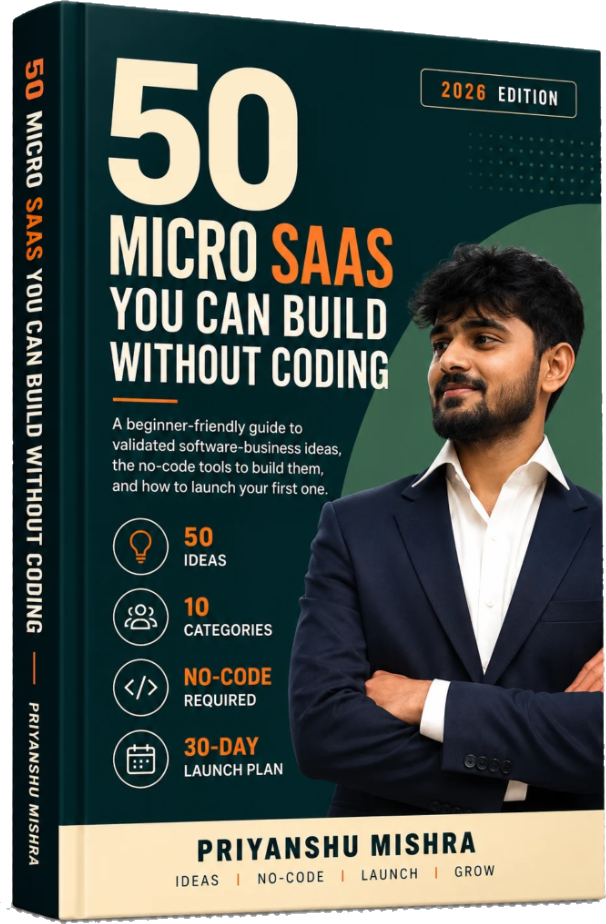
Discover 50 focused, validated software business ideas you can build with modern no-code tools — even if you've never written a single line of code.
Starting Software Shouldn't Require a Computer Science Degree
Thousands of ambitious people want to build profitable online software, but get derailed by common roadblocks before they ever write or launch a single product.
I can't code.
You assume building software requires mastering React, SQL, and AWS — or paying a dev agency $30,000+. Today, visual app builders assemble complete applications from pre-built logic blocks without writing a single line of code.
I have an idea but don't know what to build.
Vague concepts like "an AI platform for businesses" die quickly. What works are hyper-focused tools solving one sharp, specific problem for one clearly identifiable customer who already has budget.
I don't know which SaaS ideas are realistic.
Most beginners attempt massive social networks or marketplace platforms that take teams of 20 people. Micro-SaaS succeeds by focusing on narrow, high-utility utilities built by a single solo founder.
I don't know what tools to use.
With hundreds of no-code platforms on the market, analysis paralysis is rampant. The eBook lays out exact tool combinations (e.g. Softr + Airtable + Stripe) tailored to every specific idea.
I don't know who would pay.
Consumers hate paying subscriptions. Small businesses, independent creators, and niche specialists gladly pay $15–$79/month if a tool automates their headaches, prevents lost revenue, or saves hours each week.
I don't know how to validate or where to start.
Founders waste 6 months building in isolation only to hear crickets. The book gives you an honest 3-question idea filter and a 30-day step-by-step roadmap so you validate demand before touching a single builder.
The Bottleneck Has Shifted
The question is no longer "Can I code this?" — the question is "Do I understand a specific problem well enough to solve it?" This book gives you 50 validated blueprints and the exact toolkit to make it real.
Everything You Need to Go from Idea to First User
A comprehensive, no-fluff guide designed for practical execution. Every section is built around real market demand and proven no-code stacks.
The 10 High-Opportunity Categories Covered
Niche CRMs & Client Management
Tailored workflows for tattoo studios, music teachers, event planners, and photographers.
Booking & Scheduling Tools
Class capacity caps, equipment rental schedules, multi-location salons, and home services.
AI-Powered Content & Marketing Tools
Blog repurposing, SEO fix suggestions, podcast show-notes, and eCommerce copy generators.
Community & Creator Monetization Tools
Gated hobby spaces, testimonial collection widgets, niche marketplaces, and certificate generators.
E-Commerce & Online Store Add-Ons
Lightweight abandoned cart recovery, subscription boxes, return portals, and multi-channel inventory sync.
Business Operations & Productivity
Employee shift swaps, freelancer invoicing, B2B supplier portals, and clinic compliance checklists.
Finance & Billing Tools
Indie MRR dashboards, automated late-invoice chasers, team expense splitters, and tax trackers.
Real Estate & Property Tools
Lease maintenance portals, digital open-house sign-ins, tenant screening, and vacation cleaning schedulers.
Health, Fitness & Wellness Tools
Trainer client tracking, meal plan builders, telehealth intake, and habit check-ins.
Data, Analytics & Reporting Tools
Newsletter analytics, cross-platform podcast tracking, Etsy seasonal sales, and client reporting dashboards.
Sample Ideas Directly from the eBook
Explore 10 real examples from the book. Notice the clarity: each idea specifies the exact problem, customer, realistic price point, and visual no-code stack.
Not a Random List. A Systematic 5-Point Analysis.
Every single idea in Part Two is rigorously structured across the same five criteria so you can evaluate opportunities objectively and move with confidence.
The Problem
What is painful or broken?
Identifies the exact friction, scattered spreadsheets, lost revenue, or manual hours currently draining the customer.
The Solution
What does the SaaS do?
Defines the single core loop and focused workflow that solves the problem without unnecessary feature bloat.
Who Pays
Who is the buyer?
Targets the specific niche professional, studio owner, agency, or creator who already possesses a budget to pay.
Monetization
How do you charge?
Recommends realistic monthly recurring pricing ($15–$89/mo) or commission models aligned with niche expectations.
No-Code Stack
Which tools build it?
Prescribes the exact combination of database, front end, automations, and payments needed to assemble the MVP in weeks.
Is This Guide Right for You?
We believe in honest alignment. Here is an upfront breakdown of who will extract immense value from this playbook — and who should pass.
This eBook is for you if...
- Beginners & Non-Coders: You want to build and launch software products without learning programming languages or writing syntax.
- Students & Aspiring Builders: You want hands-on, portfolio-worthy software ventures with real-world recurring revenue models.
- Freelancers & Agency Owners: You want to productize your repetitive client workflows and transition from hourly work to subscription income.
- Solopreneurs & Indie Creators: You want realistic, low-overhead software projects you can realistically build, run, and scale alone.
- AI & No-Code Enthusiasts: You want to learn how modern AI APIs, Airtable databases, and visual builders combine into high-utility apps.
This may NOT be for you if...
- You expect a guaranteed business model: Building a SaaS requires execution, talking to real customers, and iterating based on honest feedback.
- You want pre-coded turnkey apps: This eBook gives you validated blueprints, architecture, and step-by-step guidance — not a ZIP file of source code.
- You want "get-rich-quick" promises: Micro-SaaS is closer to building a durable, lean local business than winning the startup lottery.
- You refuse to talk to potential users: If you plan to build for 6 months in secret without validating demand first, this methodology is not for you.
Why Focused Beats Massive Every Time
A Micro-SaaS hyper-focuses on one narrow problem for one specific type of customer, charges a modest recurring fee, and stays lean and profitable.
Narrow Enough to Own
"A CRM for everyone" loses to Salesforce and HubSpot. "A CRM for independent music teachers" can dominate its niche with virtually zero enterprise competition.
Painful Enough to Pay
The problem already costs the customer real time or lost revenue. A mild inconvenience rarely converts into a recurring subscription; painful friction does.
Lean Operations ($50–$150/mo)
Operating costs stay exceptionally low: $29–$79 for an app builder, little to nothing for a database until you scale, and standard Stripe transaction fees.
The No-Code Toolkit Explained
Forms, databases, scheduling, email automations, and payments are solved problems. You are assembling proven building blocks, not reinventing them.
Bubble
App BuilderFull-stack web application builder with complex logic, user authentication, and relational database controls.
Softr
App BuilderTurns Airtable or Google Sheets into client portals, dashboards, and directories with gated user permissions.
Glide
Mobile App BuilderCreates mobile-first progressive web apps directly from spreadsheet data in minutes for trainers and on-the-go teams.
Adalo
App BuilderVisual drag-and-drop mobile application builder capable of publishing native iOS and Android apps.
Webflow & Framer
Websites & CMSProfessional marketing frontends, digital product storefronts, and waitlist pages with high-converting design freedom.
Carrd
Landing PagesUltra-fast, responsive one-page landing sites used to validate ideas and capture early customer deposits in 24 hours.
Airtable
Database BackendPowerful relational spreadsheet-database that stores user accounts, rosters, inventory, and activity logs.
Google Sheets
Spreadsheet BackendAccessible, ubiquitous data store for lightweight prototypes, habit trackers, and simple customer directories.
Zapier & Make
AutomationsConnects disparate tools together: automatically triggering welcome emails, sending SMS alerts, and updating records.
Stripe
Payments & BillingHandles recurring subscriptions, free trials, customer portals, and one-click invoicing without handling credit cards yourself.
AI APIs
IntelligencePlugs hosted LLM capabilities (summaries, copy generation, SEO analysis, show notes) directly into visual app builders.
“Don't Build First. Validate First.”
Before opening Bubble or Softr, spend one week talking to real potential users. You are listening for a specific, painful, recurring cost — in time or money — not polite compliments.
Score Your Idea Against 3 Filters
Do you understand the audience? Can you name 5 real people who have this problem today? Can you picture the no-code stack?
Conduct 5–10 Discovery Interviews
Ask how they solve the problem today, what tools they've tried, and what they'd be willing to pay for an automated fix.
Run a Simple Pre-Sell Test
Set up a simple Carrd page asking visitors to join a waitlist or place a small deposit. If nobody commits even a few dollars, pivot before building.
“The real winners come from picking the idea closest to a problem you already understand, then talking to five real potential customers before you build anything.”
Your 30-Day Launch Plan
Most ideas in this book can go from a blank screen to a working, paid product in four to eight weeks of part-time work. Here is the exact week-by-week playbook.
Validate
Talk to 5–10 potential customers. Confirm the problem, test the price they'd pay, and discover where they currently look for solutions.
Design Core Loop
Sketch the single most important workflow (e.g. book a class, log a client visit, send an invoice). Resist adding extra features — the MVP should do one thing well.
Build the MVP
Assemble the no-code stack: database, front end, payments, and 1–2 automations. Aim for something a real customer could use end-to-end.
Launch Small
Onboard your first 5–10 users personally. Watch how they actually use the app, eliminate friction points, and only then open it up broadly.
Look Inside the eBook
Click on any page below to inspect high-resolution excerpts taken directly from the practical 2026 PDF guide.
Book 3D Edition
2026 Edition · Priyanshu Mishra
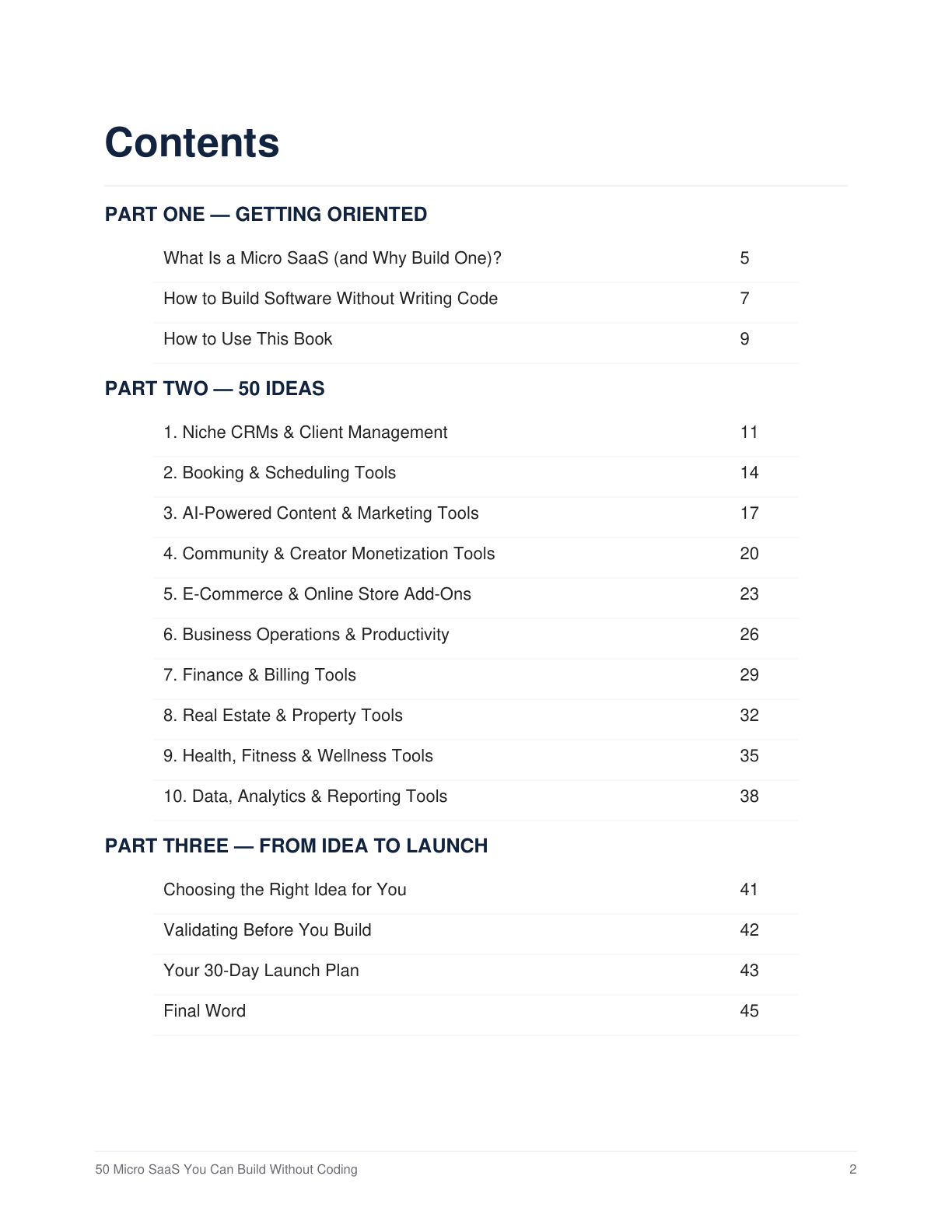
Table of Contents
Page 2 · 10 Categories Breakdown
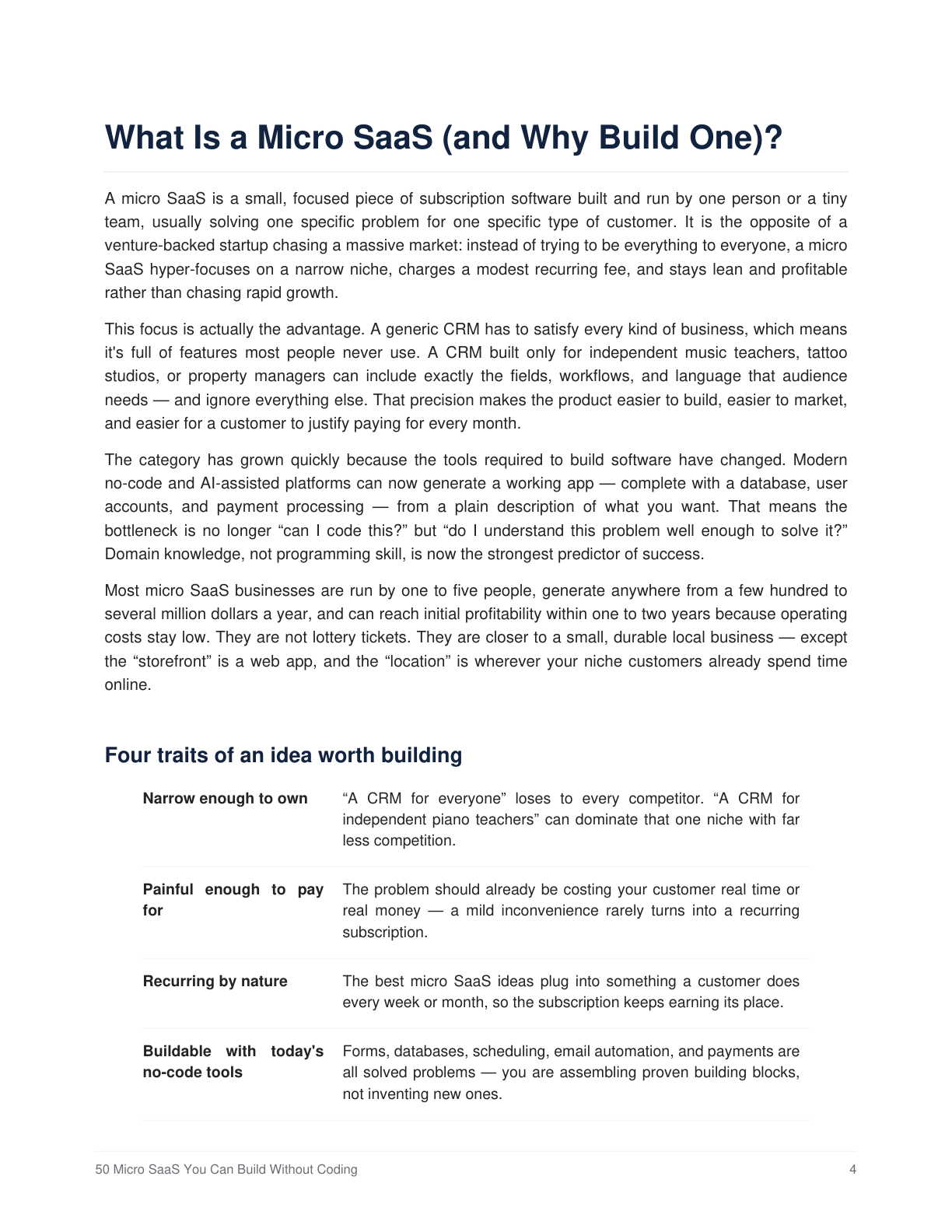
What Is Micro-SaaS?
Page 4 · Four Traits of a Winning Idea
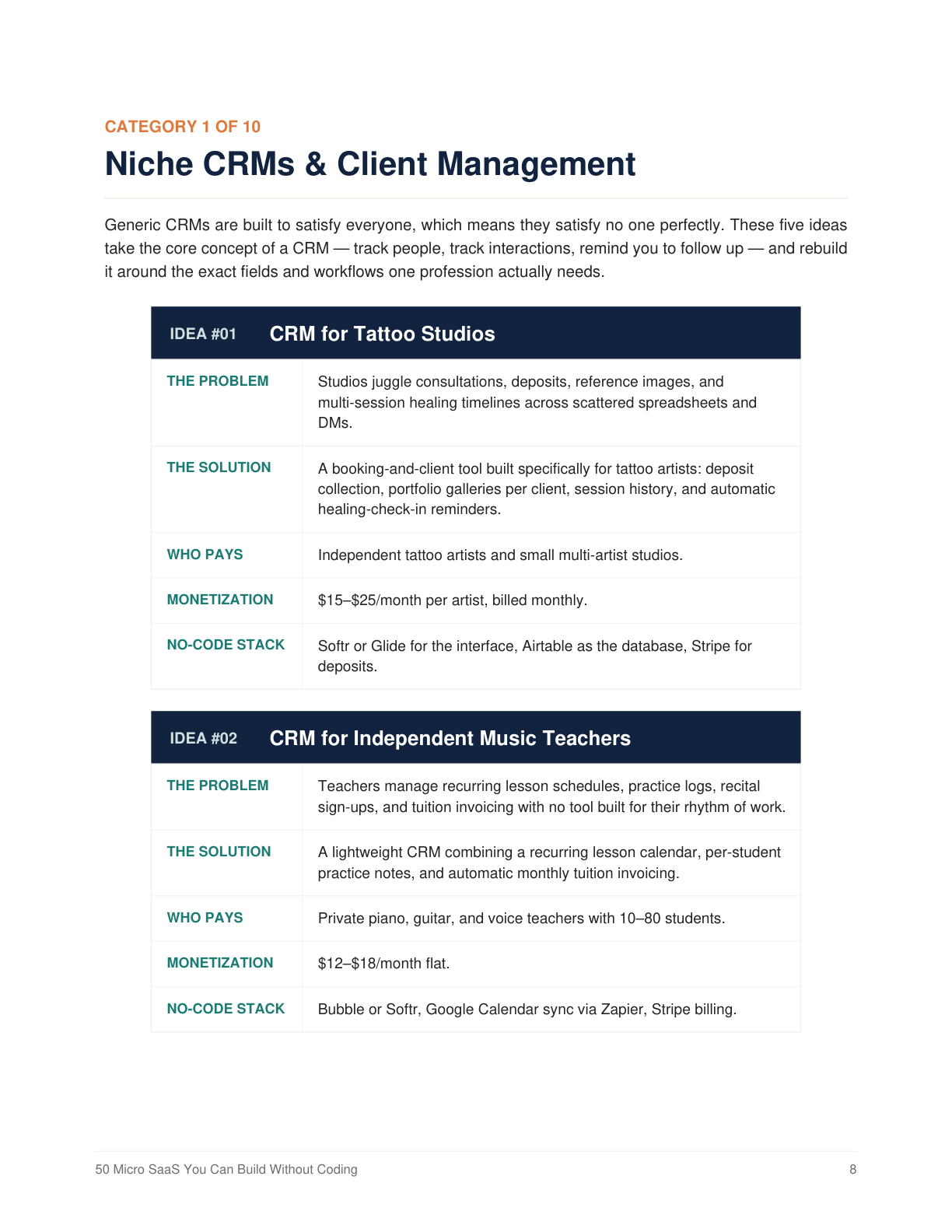
Category 1: Niche CRMs
Page 8 · Tattoo & Music Teacher CRMs
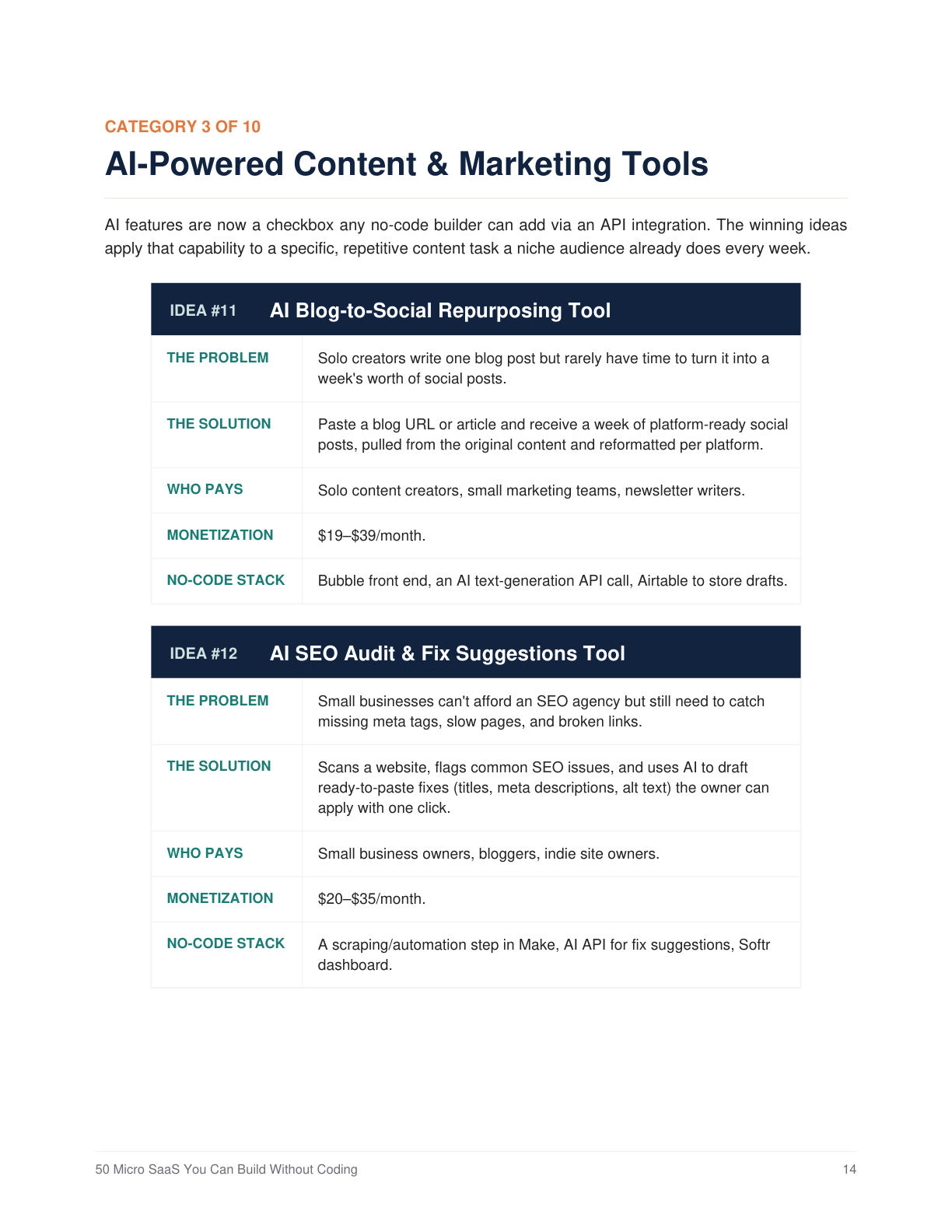
Category 3: AI Tools
Page 14 · Content Repurposing & SEO Fixes
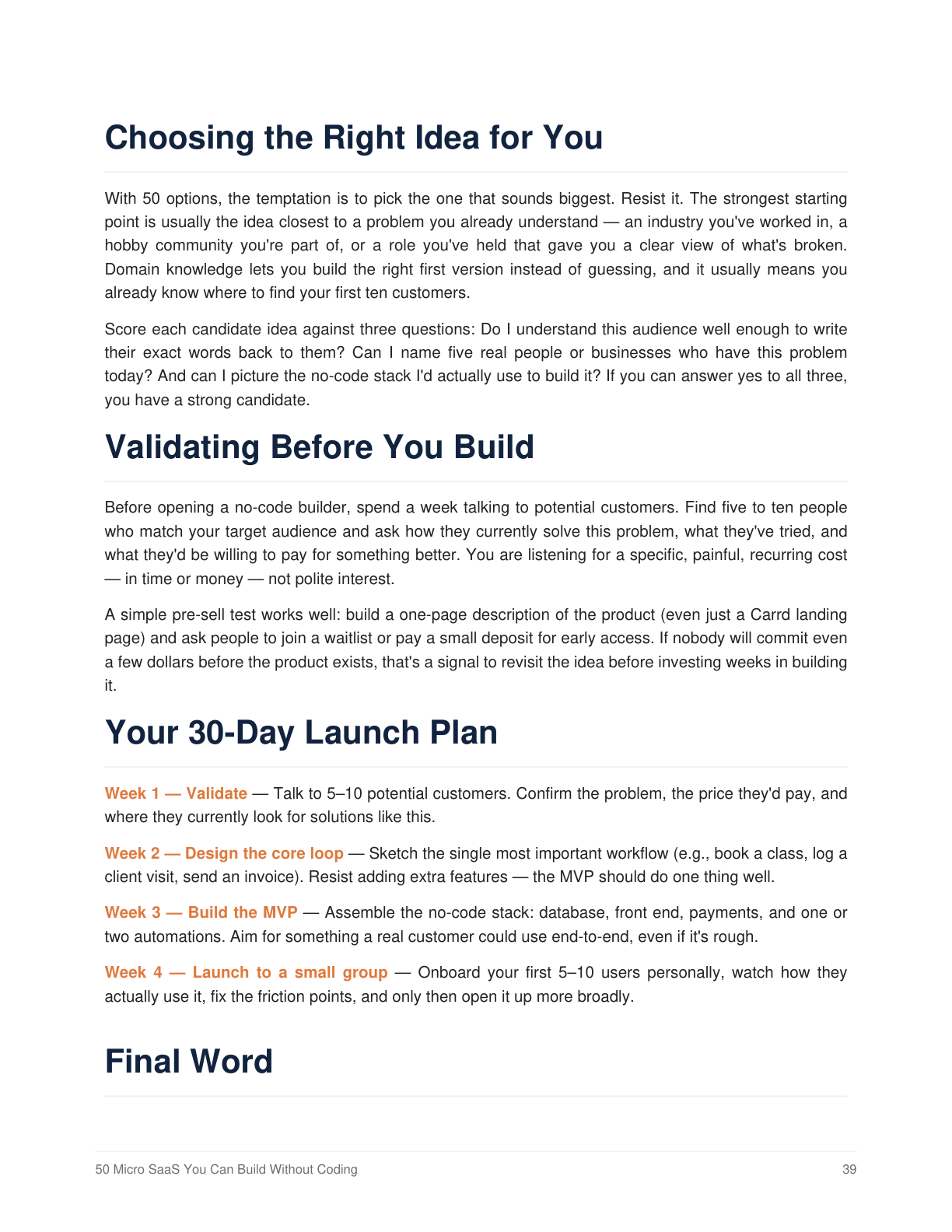
30-Day Launch Plan
Page 39 · Validation & Week-by-Week Guide
Get the Complete eBook
Instant digital access to all 50 blueprints, no-code stack recommendations, customer validation guides, and the 30-day launch roadmap.
- 50 Validated Micro-SaaS Ideas: Complete with Problem, Solution, Who Pays, Pricing & Stack breakdowns.
- 10 High-Opportunity Categories: CRMs, Booking, AI, Creators, E-Commerce, Operations, Finance, Real Estate, Health, Analytics.
- The No-Code Toolkit Breakdown: Recommendations for Bubble, Softr, Glide, Airtable, Zapier, Stripe, and AI APIs.
- Validation & Interview Playbook: How to pre-sell and interview potential users before building.
- 30-Day Step-by-Step Launch Plan: From initial idea to your first 5–10 onboarded users.
Frequently Asked Questions
Honest answers to common questions about the eBook, technical requirements, and the Micro-SaaS business model.
Your next software idea could be smaller than you think.
You don't need a million users or a venture capital round. You need one specific problem, five real customers, and the discipline to ship a simple, working solution.
Get the eBook Now — Just ₹199